- 1. Why certification matters for cosmetic and personal care packaging
- 1.1 Direct-contact packaging and potential risks
- 1.2 Certification as a quality control mechanism
- 2. Monobloc aluminum bottle structure and its implications for safety
- 2.1 One-piece structure and mechanical integrity
- 2.2 Impact of structure on sealing and stability
- 3. Material safety and formulation compatibility
- 4. Manufacturing standards and controlled environments
- 5. Quality control, testing, and traceability
- 6. Compliance requirements in international markets
- 7. Practical applications in cosmetics and personal care
- 8. Conclusion
In the cosmetics and personal care industry, packaging does not only serve a containment function but directly affects product safety, formulation stability, and regulatory compliance across different markets. For monobloc aluminum bottles, certification and safety requirements are not optional additions but form the foundation for assessing packaging suitability for direct consumer-contact applications.
Why certification matters for cosmetic and personal care packaging
Direct-contact packaging and potential risks
Cosmetic and personal care products are typically applied directly to the skin and used repeatedly over long periods. As a result, any risks arising from packaging materials may accumulate over time and affect end users.
Certification as a quality control mechanism
Certification systems help demonstrate that packaging materials and manufacturing processes comply with recognized standards. For monobloc aluminum bottles, certification indicates that:
- Materials are suitable for cosmetic and personal care applications
- Manufacturing processes are controlled and consistent
- Risks related to contamination or material interaction are minimized
Rather than being a procedural formality, certification functions as a practical tool for quality assurance and regulatory compliance.
Monobloc aluminum bottle structure and its implications for safety
One-piece structure and mechanical integrity
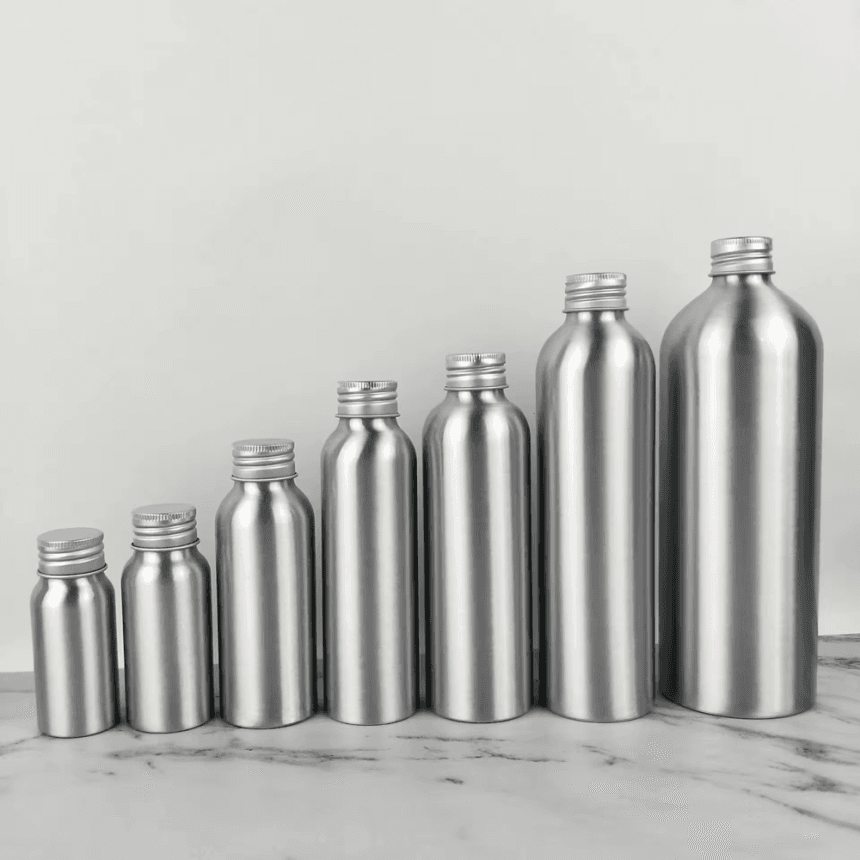
Monobloc aluminum bottles are formed from a single aluminum slug without longitudinal seams. This reduces structural weak points and limits the risk of leakage or cracking during use.
The absence of welds or joints helps reduce the risk of leakage, contamination, and structural degradation. At the same time, uniform bottle walls support stable mechanical performance during filling, transportation, and use.
Impact of structure on sealing and stability
From a safety perspective, the monobloc structure helps to:
- Reduce the risk of structural damage
- Maintain sealing performance and package integrity during repeated use
- Ensure consistent performance across production batches
Material safety and formulation compatibility
One of the most critical safety factors for cosmetic packaging is the interaction between the packaging and the product formulation. Monobloc aluminum bottles are typically used with internal coatings to prevent direct contact between aluminum and the product. In cosmetic aluminum bottle systems, internal coatings play a key role in preventing interaction between aluminum and the formulation, helping maintain stability and safety throughout the product lifecycle.
To ensure safety, internal coating systems must be carefully selected and tightly controlled, with requirements such as:
- Compatibility with a wide range of cosmetic ingredients
- Resistance to alcohols, fragrances, and active components
- Stability during long-term storage and repeated use
Manufacturing standards and controlled environments
Certifications related to manufacturing standards play a central role in ensuring safety and consistent quality. For monobloc aluminum bottles used in cosmetics and personal care, controlled production environments help reduce variability and limit risk.
These standards typically include:
- Process control at forming, coating, and finishing stages
- Clean manufacturing practices to reduce contamination risk
- Production data recording and traceability systems
Compliance with these standards reflects how quality is managed on a day-to-day basis, not solely through final product inspection.
Quality control, testing, and traceability
The safety of cosmetic packaging depends on the combined performance of materials, processes, and control systems. For monobloc aluminum bottles, inspection and traceability activities help identify potential deviations at an early stage.
Quality control systems typically include:
- Dimensional and surface inspections
- Evaluation of coating adhesion and integrity
- Batch identification and traceability when required
These measures help ensure that issues are addressed before packaging enters the cosmetic supply chain.
Compliance requirements in international markets
Cosmetics and personal care products are often distributed across multiple regions with different regulatory requirements. Packaging must therefore be evaluated based on its ability to meet international compliance expectations.
While regulatory details may vary between markets, certification systems and safety documentation help to:
- Support evaluation when entering new markets
- Reduce the risk of regulatory non-compliance
- Increase confidence in multi-market distribution
Monobloc aluminum bottles designed around certification and safety requirements are better suited for global distribution models.
Practical applications in cosmetics and personal care
In real-world use, monobloc aluminum bottles are applied to products that require formulation protection, stable appearance, and a high level of safety. Common scenarios include long-term storage, transportation across multiple climate zones, and repeated consumer use.
In these situations, certified manufacturing processes and controlled material selection help ensure that packaging maintains stable performance throughout the product lifecycle.
Conclusion
For cosmetics and personal care applications, monobloc aluminum bottles must meet strict certification and safety requirements to be considered suitable packaging solutions. From material compatibility and controlled manufacturing environments to testing and traceability, these factors work together to reduce risk and maintain consistent quality.