Aluminum Spray Bottles (Pump / Trigger / Fine Mist): Switch from Plastic to Aluminum
Packaging transition in the spray bottle segment
For many years, plastic packaging has been the common choice thanks to its cost efficiency and flexible processing. However, as product portfolios expand and quality control requirements become stricter, the limitations of plastic packaging are becoming increasingly apparent.
For frequently used spray products, packaging must do more than contain the product. It must also maintain consistent spray performance throughout the product’s entire lifecycle. This has led brands to reassess packaging materials as part of product optimization strategies, especially as cosmetic spray products increasingly shift toward aluminum spray bottles as an upgrade in control and user experience.
Limitations of plastic packaging in spray bottles
Spray stability and pressure retention
During use, plastic bottles may experience slight deformation due to mechanical pressure or environmental conditions. In spray packaging, these deformations can affect internal pressure retention, leading to inconsistent spray output.
For cosmetic spray products, this instability can negatively impact perceived quality. For pharmaceutical spray applications, changes in pressure or spray performance represent a higher-risk factor that requires stricter control.
Long-term use and distribution risks
Plastic packaging is also more vulnerable during storage and transportation under fluctuating temperature and humidity conditions. In extended distribution chains, particularly in tropical markets, risks such as deformation or material instability may arise if not properly controlled.
These risks often prompt brands to reassess the suitability of plastic when expanding into new markets or upgrading product positioning. Such issues are even more critical in pharmaceutical spray applications, where switching to aluminum pharmaceutical spray bottles is closely associated with higher requirements for stability, safety, and market acceptance.
Why aluminum is becoming the preferred alternative for spray bottles
Mechanical stability and spray control
Aluminum offers higher rigidity and better shape retention throughout use. This helps maintain stable internal pressure, supporting a more consistent and uniform spray pattern with each use.
For daily-use products, this stability improves user experience and reduces dosage variation, an important factor in quality control.
Contact safety and material stability
In personal care and household applications, packaging remains in indirect contact with the product over long periods. Using a highly stable material helps reduce the risk of material changes caused by environmental exposure, especially during storage and distribution under varying conditions.
This is one of the key reasons aluminum is increasingly considered for products that require higher levels of safety and material stability.
Impact of material transition on product strategy
Influence on product positioning and segmentation
In cosmetic and pharmaceutical spray products, packaging is not only a technical component but also a strategic element in product positioning. With the same formulation, differences in packaging material can clearly distinguish product segments, from standard lines to premium or tightly controlled applications.
Brands often leverage the transition from plastic to aluminum as part of portfolio restructuring, creating clearer separation between product tiers based on investment level, distribution channels, and target markets. In this context, packaging becomes an active tool in long-term category management and positioning.
Supporting portfolio expansion and target markets
From a strategic perspective, standardizing aluminum packaging across spray product lines enables more flexible deployment. When expanding product ranges or entering markets with higher requirements, aluminum packaging is often preferred due to its superior appearance, finishing quality, and distribution control.
This approach allows brands to expand products or markets without restructuring their entire portfolio or brand image. This is especially relevant in markets where cosmetics and pharmaceuticals are clearly distinguished, and packaging material selection plays a role in regulatory and consumer perception.
Impact on brand image and user perception
Handling feel and finishing quality
In the personal care segment, tactile feel and packaging finish directly influence quality perception. Aluminum spray bottles provide a more solid and consistent feel throughout use, resulting in a more stable user experience over time.
Visual consistency on shelves
For products displayed over extended periods, the ability to maintain original appearance helps preserve brand image throughout distribution. This is particularly important for brands positioned in the mid to premium segments.
Key considerations before switching from plastic to aluminum
Formulation and usage conditions
Before transitioning, brands should evaluate formulation compatibility with the new packaging material, as well as real-world usage conditions.
Supply chain and cost assessment
Beyond technical factors, impacts on supply chain structure, logistics costs, and supply stability should be assessed to avoid unexpected risks during implementation.
FAQ – Switching from plastic to aluminum in spray bottles
Does switching to aluminum affect spray performance?
When properly specified and implemented, spray performance is typically more stable and consistent.
Is it necessary to replace the entire spray system?
In many cases, existing systems can still be used if technical compatibility is ensured.
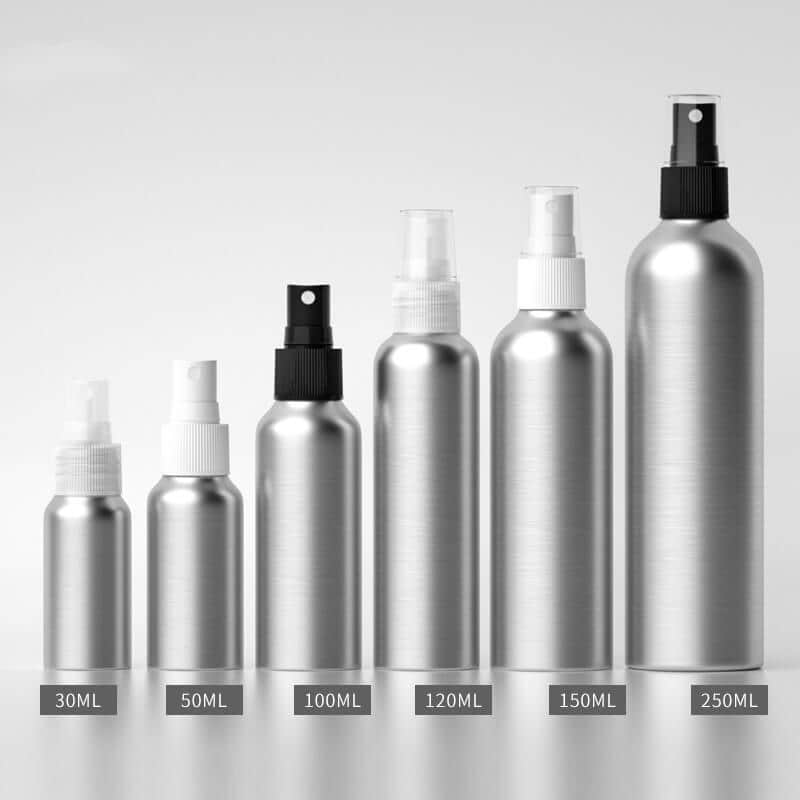
Is 100 ml suitable for aluminum spray bottles?
Yes. This is a common size widely used in spray product applications.
Conclusion
Switching from plastic to aluminum in spray bottles is not simply a material change, but a strategic adjustment affecting performance, safety, and portfolio management. When implemented correctly, solutions such as aluminum cosmetic spray bottles and aluminum pharmaceutical spray bottles help brands balance user experience, risk control, and long-term development goals.